The Farmer Who Never Missed a Bell
His name was Giuseppe. He was 78 years old and had worked the same wheat fields in Lombardy, northern Italy, for sixty years.
Every morning at 6 a.m., every noon, and every evening at 6 p.m., he would stop. No matter what was happening — plowing, harvesting, mending fences — he would stop. He would remove his hat. He would bow his head. And he would pray.
His grandson asked him once: “Nonno, why do you always stop at those hours?”
Giuseppe looked at the boy. He said: “Because the bell rings. And when the bell rings, God is reminding me of the day He entered the world. I should not ignore that.”
That prayer was the Angelus prayer. It is one of the oldest daily devotions in the Catholic Church. For centuries, it has been the heartbeat of Catholic life — prayed in fields, in kitchens, in monasteries, and in St. Peter’s Square by the Pope himself every Sunday at noon.
This guide gives you everything you need. The full text. The meaning of every line. The history. And exactly how to pray it — so it becomes more than words on a page.
What Is the Angelus Prayer?
The Angelus (pronounced AHN-juh-lus) is a short Catholic devotion that honors the Incarnation — the moment when God became human in the person of Jesus Christ. The word comes from Latin and means angel.
The prayer takes its name from its opening words in Latin: Angelus Domini nuntiavit Mariae — “The Angel of the Lord declared unto Mary.” Those words describe the Annunciation, the moment the Angel Gabriel told Mary she would carry the Son of God.
It is traditionally prayed three times a day: at 6 a.m., noon, and 6 p.m. Each recitation takes about two minutes. It is one of the simplest and most ancient devotions a Catholic can practice.
Angelus Prayer: Full Text in English
Here is the complete text of the Angelus prayer as it is prayed today:
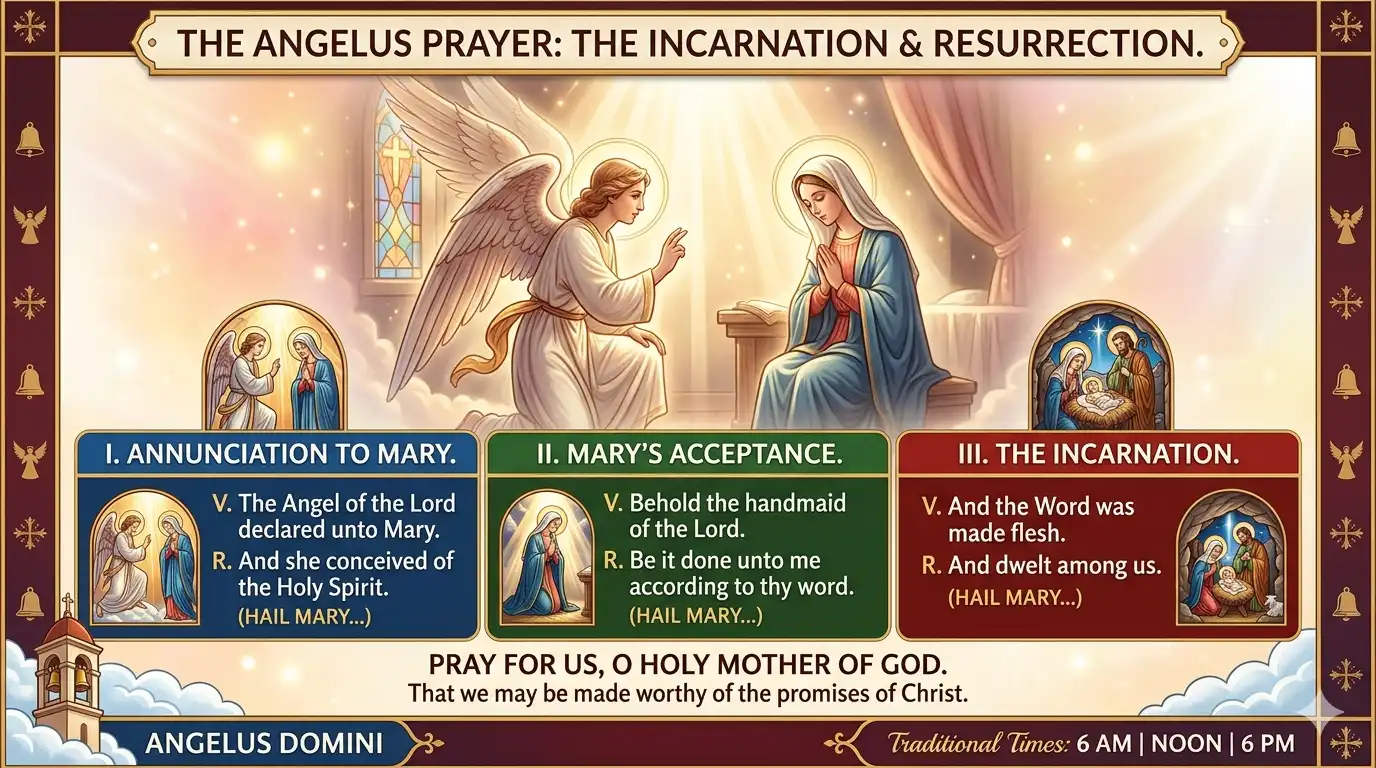
V. The Angel of the Lord declared unto Mary.
R. And she conceived of the Holy Spirit.
Hail Mary, full of grace, the Lord is with thee.
Blessed art thou amongst women,
and blessed is the fruit of thy womb, Jesus.
Holy Mary, Mother of God,
pray for us sinners,
now and at the hour of our death. Amen.
V. Behold the handmaid of the Lord.
R. Be it done unto me according to thy word.
Hail Mary…
V. And the Word was made flesh.
R. And dwelt among us.
Hail Mary…
V. Pray for us, O holy Mother of God.
R. That we may be made worthy of the promises of Christ.
Let us pray.
Pour forth, we beseech Thee, O Lord,
Thy grace into our hearts;
that we, to whom the Incarnation of Christ Thy Son
was made known by the message of an angel,
may by His Passion and Cross
be brought to the glory of His Resurrection,
through the same Christ our Lord. Amen.
Angelus Prayer in Latin (Original Text)
The original Latin version, still used in traditional liturgy and by the Pope on Sundays, is:
Angelus Domini nuntiavit Mariae.
Et concepit de Spiritu Sancto.
Ave Maria…
Ecce ancilla Domini.
Fiat mihi secundum verbum tuum.
Ave Maria…
Et Verbum caro factum est.
Et habitavit in nobis.
Ave Maria…
Ora pro nobis, sancta Dei Genetrix.
Ut digni efficiamur promissionibus Christi.
Oremus.
Gratiam tuam, quaesumus, Domine, mentibus nostris infunde;
ut qui, Angelo nuntiante,
Christi Filii tui incarnationem cognovimus,
per passionem eius et crucem,
ad resurrectionis gloriam perducamur.
Per eundem Christum Dominum nostrum. Amen.
History and Origin of the Angelus Prayer
The Angelus is ancient. Its roots stretch back over 800 years — to the Middle Ages, when the Catholic Church was at the center of daily life in Europe.
How It Began: The Evening Bell
The story starts in the 13th century. In 1269, St. Bonaventure — a Franciscan priest and one of the Church’s great theologians — encouraged the faithful to pray three Hail Marys when the evening bell rang. This was a simple way for ordinary people, many of whom could not read, to join the monks who were praying the Liturgy of the Hours.
The bell rang. People stopped. They prayed. This simple act of pausing your day for God became a habit across Europe.
The Morning and Noon Bells
The evening prayer came first. The morning Angelus came later, growing from the monastic custom of praying at Prime (the first hour of the day). The noon prayer developed separately — linked to the commemoration of Christ’s Passion, since Jesus was crucified at noon on Good Friday.
By the 14th century, the three-time daily practice had spread widely. Pope John XXII granted an indulgence for praying it in 1318 and 1327 — a formal Church blessing on the devotion.
The Prayer Takes Its Final Shape
The full structured form of the Angelus — with versicles, responses, Hail Marys, and the closing prayer — was standardized by the 17th century. The earliest record of the three versicles appears in an Italian catechism printed in Venice in 1560. The fuller form used today dates to around 1612.
The Pope and the Angelus Today
Since 1964, every Pope has prayed the Angelus publicly every Sunday at noon in St. Peter’s Square. Tens of thousands of pilgrims gather. Millions watch on television and online. The tradition continues today, making the Angelus one of the most watched moments in Catholic life worldwide.
What Does the Angelus Mean? Line by Line
Each line of the Angelus is rooted in Scripture. Here is a plain-language explanation of what you are saying — and why it matters.
“The Angel of the Lord declared unto Mary”
This is the Annunciation — the moment the Angel Gabriel appeared to Mary (Luke 1:26–38). You are stepping back into that moment. You are remembering the day God’s plan for salvation began. It is not history. It is something alive and real.
“And she conceived of the Holy Spirit”
Mary said yes. In that instant, God became human. The Incarnation happened. Everything in Christianity flows from this moment. When you say these words, you are not just recalling a fact — you are standing in awe of it.
“Behold the handmaid of the Lord — Be it done unto me according to thy word”
These are Mary’s own words from the Gospel of Luke. She did not resist or ask for time to think. She said yes completely. This line invites you to ask: Am I saying yes to God in my own life today?
“And the Word was made flesh — And dwelt among us”
From the Gospel of John (1:14). This is the theological center of the prayer. The Word — the eternal Son of God — took on a human body. He became one of us. This is why the Angelus is prayed: to remember that God came to live in our world.
“Pour forth, we beseech Thee, O Lord, Thy grace into our hearts”
The closing prayer connects the Incarnation to the Resurrection. It asks God for the grace to go from the Cross to the glory of Easter. It brings the whole mystery of salvation into a single breath of prayer.
When and How to Pray the Angelus
The Three Times
The traditional hours are:
6 a.m. at the start of the day, to offer your morning to God
Noon a midday pause, linked to the hour of the Crucifixion
Evening. at the close of the workday, to give thanks
You do not need to pray it at all three times to benefit. Many Catholics pray it once a day, usually at noon. Any one of the three is a good place to start.
How to Pray It: Step by Step
1. Stop what you are doing. Even for two minutes.
2. If you are in a group, one person leads the versicles (V.) and the rest respond (R.).
3. Pray the three versicles and their responses, each followed by a full Hail Mary.
4. Say the versicle: “Pray for us, O holy Mother of God” / response: “That we may be made worthy of the promises of Christ.”
5. Conclude with the closing prayer beginning “Pour forth, we beseech Thee, O Lord…”
6. Optionally, add three Glory Bes and an Eternal Rest in thanksgiving.
Posture
Traditionally, the Angelus is prayed while kneeling — except on Sundays and Saturday evenings, when you stand. However, the Church allows any posture if kneeling is not practical. The prayer is the priority, not the position.
Using an Alarm or App
Many Catholics set a phone alarm for 6 a.m., noon, and 6 p.m. Some Catholic apps include an Angelus bell timer. The bells used to do this job for centuries — today, a phone notification serves the same purpose.
The Angelus and the Regina Caeli: What Changes at Easter
From Easter Sunday until Pentecost, the Angelus is replaced by the Regina Caeli (“Queen of Heaven”). This shift happens every year.
The Angelus celebrates the Incarnation — God entering the world. The Regina Caeli celebrates the Resurrection — God conquering death. Easter is a season of joy, and the joyful Regina Caeli fits that season better.
The Regina Caeli begins:
Queen of Heaven, rejoice, alleluia!
For He whom you were worthy to bear, alleluia!
Has risen, as He said, alleluia!
Pray for us to God, alleluia!
After Pentecost Sunday, the Angelus resumes and continues until the following Easter.
Common Mistakes When Praying the Angelus
Rushing Through It
The Angelus takes about two minutes when prayed well. Many people treat it as a checklist. Instead, pause on the versicles. Let “And the Word was made flesh” actually land. These words describe the most important event in human history.
Forgetting the Closing Prayer
Many people know the versicles and Hail Marys but skip the concluding prayer (“Pour forth, we beseech Thee…”). This prayer is essential. It connects the Annunciation to the Passion and Resurrection — it ties the whole mystery together.
Only Praying It on Sundays
The Angelus is a daily devotion. Sunday is when the Pope prays it publicly, but it is meant for every morning, noon, and evening of every day. Start with once a day and build from there.
Praying It Alone Only
The Angelus was designed for community — for families, for villages, for monasteries. If you have children, pray it with them. If you have a spouse, pray it together. It takes two minutes and builds a shared habit of faith.
FAQ: Angelus Prayer
Q: What does the word ‘Angelus’ mean?
It comes from Latin and means angel. The prayer takes its name from the first three words of its opening versicle in Latin: Angelus Domini nuntiavit Mariae — “The Angel of the Lord declared unto Mary.”
Q: How many Hail Marys are in the Angelus?
Three. One after each of the three versicles. The number three runs throughout the prayer — three versicles, three Hail Marys, and traditionally prayed three times a day.
Q: Is the Angelus the same as the Rosary?
No. They are two different devotions. The Rosary is a longer prayer meditating on the mysteries of Christ’s life, death, and resurrection. The Angelus is shorter — about two minutes — and focuses specifically on the Incarnation and the Annunciation. The Rosary takes about 20 minutes.
Q: Why does the Pope pray the Angelus in St. Peter’s Square?
Since 1964, every Pope has prayed a public Angelus every Sunday at noon in St. Peter’s Square. The Pope gives a short Gospel reflection first, then leads the prayer. It is broadcast worldwide. This tradition keeps the prayer at the heart of global Catholic life.
Q: Can I pray the Angelus if I am not Catholic?
The Angelus is a specifically Catholic devotion, but there is nothing preventing a non-Catholic Christian from praying it. Some Anglican and Lutheran communities also observe the Angelus. The prayer’s focus — the Incarnation, Mary’s yes, God becoming human — is meaningful to all Christians.
Q: What is the difference between the Angelus and the Regina Caeli?
The Angelus is prayed from after Pentecost until Holy Saturday. It focuses on the Incarnation. The Regina Caeli replaces it during the Easter season (Easter Sunday to Pentecost). It focuses on the Resurrection. Same three daily times, different prayer.
Q: Do I have to say it at exactly 6 a.m., noon, and 6 p.m.?
No. The Church says the prayer should be said “approximately” at those hours. A few minutes early or late is fine. What matters is the habit, not the exact minute.
Q: Is there an indulgence for the Angelus?
Yes. The Church has granted indulgences for the Angelus since the time of Pope John XXII in the 14th century. Praying it with devotion, at approximately the correct times, in a state of grace, fulfills the conditions.
Conclusion: Two Minutes That Change the Day
Giuseppe, the farmer from Lombardy, knew something that took his grandson years to understand.
He was not stopping for a habit. He was stopping for a Person.
The Angelus prayer is a two-minute act that says: I believe God entered this world. I believe Mary said yes. I believe that yes changed everything. And I want to remember that — at dawn, at noon, and at sunset.
In a world that never stops moving, the Angelus asks you to stop three times. Just for a moment. Just to remember what matters most.
Cardinal John Henry Newman wrote that praying the Angelus devoutly every day is part of what he called “a perfect day.” He did not mean a day without problems. He meant a day anchored in God.
Start tomorrow. Set one alarm. Noon. Pray the three versicles, the three Hail Marys, and the closing prayer. Two minutes.
Then see what happens to your day.
“And the Word was made flesh — and dwelt among us.”
That is the whole prayer. That is the whole point.

Sarah J. Coleman is a Christian author and prayer ministry leader with 14+ years of experience. She is the founder of Rooted in Prayer Ministries, a community of 40,000+ women worldwide. Sarah holds a BA in Biblical Studies from Belmont University and is a certified Christian counselor. She has been featured on Proverbs 31 Ministries, iBelieve.com, and Crosswalk.com. Every article she writes is rooted in scripture and shaped by real ministry experience.