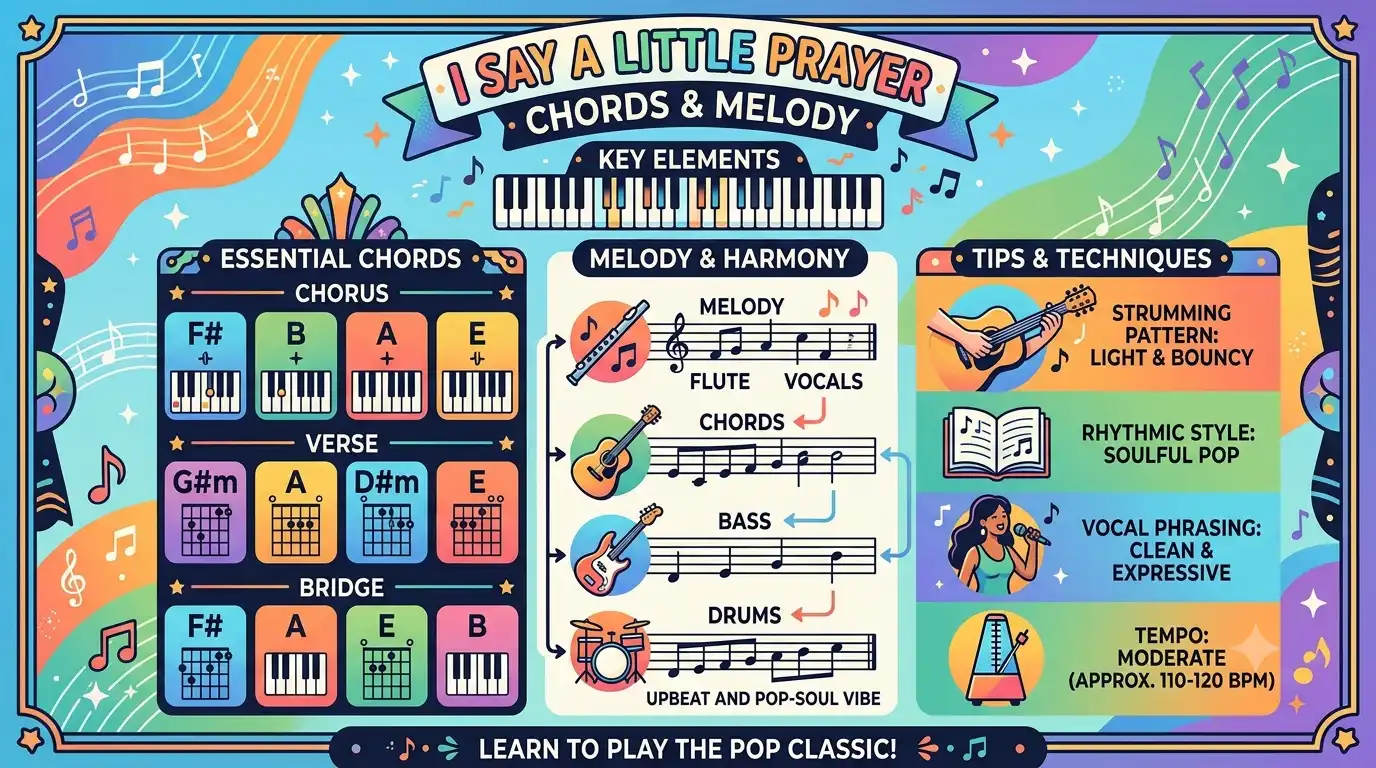
A few years ago, a friend asked me to play a classic soul song at a weekend acoustic session. I chose Burt Bacharach’s famous hit, thinking it would be an easy three-chord pop song. But as soon as I sat down with my guitar, the fast chord switches and changing time counts left my hands confused. I spent three full days breaking down Dionne Warwick’s original track and Aretha Franklin’s iconic soul cover. When I finally hit that smooth chorus transition, the whole room sang along with complete joy.
If you are searching for i say a little prayer chords, this guide is written for you. Learning this song will elevate your playing, improve your finger transition speed, and help you master syncopated soul rhythms. Whether you need an easy capo option or advanced jazz voicings, this guide gives you everything you need to play with confidence.
1. Song Overview & Key Differences: Aretha Franklin vs. Dionne Warwick
Before you pick up your instrument, you should know the two major versions of this iconic song. Burt Bacharach and Hal David wrote this masterpiece in 1967 for Dionne Warwick, and Aretha Franklin released her famous cover in 1968.
- Dionne Warwick Version: Played in the key of $G\text{maj7}$ / $Em$. It uses smooth pop-jazz inversions and soft brass melodies.
- Aretha Franklin Version: Played in the key of $F\#m$ (standard pitch). Aretha added a heavy gospel groove with strong piano chords.
If you play guitar, the $F\#m$ key uses several barre shapes like $F\#m$, $Bm7$, and $C\#7$. Putting a capo on the 2nd fret lets you play simple open shapes ($Em7$, $Am7$, $D7$, $G\text{maj7}$).
| Feature | Dionne Warwick Version | Aretha Franklin Version |
|---|---|---|
| Original Key | $G$ Major / $E$ Minor | $F\#$ Minor / $A$ Major |
| Tempo | ~132 BPM | ~136 BPM |
| Primary Style | Pop / Jazz Fusion | Soul / Gospel Groove |
| Capo Choice (Guitar) | No Capo ($Em$ Open) | Capo 2nd Fret (Play in $Em$) |
2. Understanding Burt Bacharach’s Time Signature Shifts ($4/4$, $10/4$, and $2/4$)
The main reason musicians find daily i say a little prayer chords tricky is the changing rhythm. Most pop tunes stay in a straight $4/4$ beat. However, this track shifts rhythm counts to match the natural flow of the lyrics.
Verse Time Pattern:
[ 4/4 Bar ] -> [ 4/4 Bar ] -> [ 4/4 Bar ] -> [ 2/4 Bar ]  (Counted as a 10/4 phrase)
In the verse (“The moment I wake up / Before I put on my makeup“), the measure shortened slightly. It runs three bars of $4/4$ followed by a fast $2/4$ bar before the next line begins.
Do not count strictly to four on every single bar. Listen closely to the singer’s vocal phrasing. Let the natural rhythm of the lyric guide your chord hands during each verse phrase.
3. Essential Open Chords Guide for Capo 2 Beginners
If you are a beginner, placing your capo on the 2nd Fret gives you a short i say a little prayer chords layout. This matches Aretha Franklin’s key while using comfortable open hand shapes.
Here are the primary open shapes you will use relative to the capo:
- Em7:
022030— Keep your ring finger on the 3rd fret of the B string for stability. - Am7:
x02213— Add your pinky on the 3rd fret of the high E string for color. - C/D:
xx0553orxx0010— Creates that smooth floating transition sound. - Gmaj7:
320002— Fret the high E string on the 2nd fret. - C:
x32010— Standard open shape. - B7:
x21202— Sharp dominant chord leading back to $Em7$.
Using open position shapes reduces finger stress. It allows you to concentrate on keeping your right-hand strumming steady and relaxed.
4. Standard Tuning Barre Chords in the Original Key of $F\#m$
For intermediate players who want to play in standard pitch without a capo, here are the exact chords in the original key of $F\#m$. This matches the original piano key used by Aretha Franklin.
- F#m:
244222— Index finger barre across all 6 strings at the 2nd fret. - Bm7:
x24232— Standard minor 7th barre shape on the 2nd fret. - E7:
020100— Open dominant shape that drives the key forward. - Amaj7:
x02120— Soft, rich major 7th open chord shape. - D:
xx0232— Bright major resolution shape. - C#7:
x46464orx4342x— Strong dominant turn to lead back to $F\#m$.
Playing without a capo gives your guitar a full bass sound on the low $F\#$ string. This adds great depth to live acoustic performances.
5. Master the Signature Intro Riff and Chord Progression
The opening of “I Say a Little Prayer” builds high energy right away. It sets up the joyful chord motif that returns between the verses.
Intro Chord Sequence:
$$ \text{\vert{}\vert{}: } F#m \quad \vert{} \quad Bm7 \quad \vert{} \quad E7 \quad \vert{} \quad A\text{maj7} \quad \vert{} \quad D \quad \vert{} \quad C#7 \quad :\vert{}\vert{} $$
Descending Lead Note Riff (High Strings):
If you play solo guitar or keyboard, play this single-note line right after hitting the $C\#7$ chord:
e|--9---9---7---5---4---2---1-----|
B|-----------------------------2--|
G|--------------------------------|
D|--------------------------------|
A|--------------------------------|
E|--------------------------------|
Notes: C#  C#  B   A   G#  F#  F  C#
Adding this descending melody gives your performance instant polish. It makes your acoustic cover sound just like the radio recording.
6. Verse 1 and 2 Chord Walkthrough (“The Moment I Wake Up”)
The verses describe morning routines transformed by love. The music relies on fast chord exchanges between minor tonic shapes and subdominant movement.
[Verse 1 - Standard Key]
F#m                   Bm7
The moment I wake up,
                  E7      Amaj7
Before I put on my makeup (makeup!),
  D                    C#7
I say a little prayer for you.

F#m                     Bm7
And while combing my hair, now,
                        E7        Amaj7
And wondering what dress to wear, now (wear, now!),
  D                    C#7
I say a little prayer for you.
Playing Tip: Hit the downbeat on $F\#m$ firmly. Then strum $Bm7$ softly before building your volume toward the $C\#7$ dominant chord.
7. Chorus Chord Progression Breakdown (“Forever and Ever”)
The chorus is the emotional heart of the song. The chord progression moves out of the somber minor key into a bright, soaring major harmony.
[Chorus - Standard Key]
D         E         C#m7      F#m
Forever, forever, you'll stay in my heart,
       A7
And I will love you.

D         E         C#m7     F#m
Forever, forever, we never will part,
       A7
Oh, how I'll love you.

D         E         C#m7     F#m
Together, together, that's how it must be,
      A7
To live without you

D                  D/E   D   C#7
Would only be heartbreak for me!
Moving from $D \rightarrow E \rightarrow C\#m7 \rightarrow F\#m$ creates a classic stepwise bassline. The $A7$ chord at the end of each phrase pulls the harmony smoothly back to $D$.
8. Bridge Call-and-Response Chord Structure (“My Darling Believe Me”)
The bridge features one of the most famous vocal call-and-response sections in music history. The chords hold a steady groove while backing vocals answer the lead line.
[Bridge - Standard Key]
F#m               Bm7
My darling, believe me,
                E7
For me there is no one...
     Amaj7
but you!
                     (Please love me too!)

             E7                      Amaj7
Answer my prayer, babe! (Answer my prayer, babe!)
             E7                      Amaj7
Say you love me too!    (Answer my prayer, babe!)
Hold the $A\text{maj7}$ shape steady while the vocal phrase finishes. If you are playing solo acoustic guitar, strum the low bass note on beat 1 and slap the high strings on beats 2 and 4 to simulate the drum groove.
9. Iconic Bass Walkdown Riff and Chromatic Transitions
To give your playing powerful i say a little prayer chords resonance, add the chromatic bass walkdown line. This is played right before returning to the chorus or at the track’s end.
Guitar Tab for Bass Walkdown (Standard Tuning):
e|-----------------------------------|
B|-----------------------------------|
G|-----------------------------------|
D|---4---2---0-----------------------|
A|---------------4---2---1-----------|
E|---------------------------4---2---|
Notes: F#  E   D   C#  B   A#  G#  F#
Capo 2 Fret Version (Relative to Capo):
e|-----------------------------------|
B|-----------------------------------|
G|---4---2---0-----------------------|
D|---------------4---2---1-----------|
A|---------------------------3---2---|
E|-----------------------------------|
Notes: B   A   G   F#  E   D#  C   B
Using this bass line adds clean structure to your arrangement. It tells singers and listeners exactly when the section changes.
10. Rich Piano and Keyboard Jazz Voicings
For keyboard players, Burt Bacharach’s score relies on rich extended voicings, inversions, and voice leading. Here are effective two-handed chord shapes:
[Key of F#m / Standard Pitch]

1. F#m9 (Intro/Verse):
   Left Hand: F#2 - C#3
   Right Hand: A3 - C#4 - E4 - G#4

2. Bm7:
   Left Hand: B1 - F#2
   Right Hand: A3 - D4 - F#4 - A4

3. E7sus4 -> E7:
   Left Hand: E2 - B2
   Right Hand: A3 - D4 - F#4 -> G#3 - D4 - E4

4. Amaj7:
   Left Hand: A1 - E2
   Right Hand: G#3 - C#4 - E4 - G#4

5. C#7alt (Leading to F#m):
   Left Hand: C#2 - G#2
   Right Hand: F3 - A3 - B3 - D#4
These keyboard voicings retain the lush soul feeling of the original recording without making the low end sound muddy.
11. Easy Ukulele Chord Guide and Strumming Shapes
“I Say a Little Prayer” sounds wonderful on the ukulele! Because of standard ukulele tuning ($G-C-E-A$), these open shapes sound bright and cheery.
Essential Ukulele Shapes:
- Em:
0432 - Am7:
0000(All strings open) - D7:
2020or2223 - Gmaj7:
0222 - C:
0003 - B7:
2120
[Ukulele Verse Progression]

Em                    Am7
The moment I wake up,
                  D7      Gmaj7
Before I put on my makeup,
  C                    B7
I say a little prayer for you.
Strum softly with the pad of your thumb. This creates a warm acoustic swing that complements the vocal melody.
12. Syncopated Soul Strumming Patterns and Rhythm Tips
Playing this song with a stiff up-and-down strum will sound flat. The secret lies in syncopation—accenting off-beats to build a real soul groove.
Recommended Strum Pattern:
Beat:    1   &   2   &   3   &   4   &
Strum:   D       D   U       U   D   U
Accent:  *       *               *
(D = Downstroke, U = Upstroke, * = Accented Strum)
Main Rhythm Rules:
- Keep Wrist Loose: Relax your right wrist completely. Lightly mute strings with your fret hand after beat 2 to get a percussive slap sound.
- Push the Off-Beats: On changes like $D \rightarrow E$ in the chorus, hit the $E$ chord on the “&” of beat 4 instead of beat 1. This syncopated push drives the energy forward.
13. How to Sing and Play “I Say a Little Prayer” Simultaneously
Singing while executing i say a little prayer chords for strength can feel tricky due to vocal pauses over changing time counts.
Vocal Line:    The mo-ment I wake up...
Chord Hit:     [F#m]        [Bm7]
Beat Count:    1   2   3    4   1   2
3 Steps to Sync Vocal and Hands:
- Isolate Bass Notes: Play only the root bass note of each chord while singing the lyrics out loud.
- Match Key Syllables: Note how key lyric words land directly on chord shifts (e.g., “wake” lands on $Bm7$, “make” lands on $A\text{maj7}$).
- Practice at Slow Speed: Drop your practice speed to 80 BPM. Once your hand muscle memory takes over, singing becomes effortless.
14. Daily Practice Routine to Build Finger Strength and Speed
Building clean finger execution requires steady effort. Use this simple 15-minute breakdown to practice daily i say a little prayer chords routines:
| Time | Practice Focus | Objective |
|---|---|---|
| Minutes 1–3 | Slow Chord Transitions | Practice clean switches between $F\#m$, $Bm7$, and $C\#7$. |
| Minutes 4–7 | Bass Walkdown Riff | Work on single-note clarity and clean timing. |
| Minutes 8–11 | Syncopated Chorus Strum | Build push-beat accuracy on $D \rightarrow E \rightarrow C\#m7$. |
| Minutes 12–15 | Playthrough with Metronome | Run the full track at target tempo without pausing. |
Consistent short daily sessions build deep muscle memory far faster than long, irregular practice sessions.
15. Deep Harmonic Analysis and Emotional Impact of the Song
Beyond simple chords, Burt Bacharach’s song is a masterpiece of pop harmony. Moving between minor verses ($F\#m$) and major choruses ($A$ Major) builds deep emotional relief for the listener.
The song uses a spiritual i say a little prayer chords progression that lifts people’s spirits. The tension of the $C\#7$ dominant chord resolves smoothly into bright major harmonies.
When you play this song, focus on that emotional shift. Soft, careful playing in the verses makes the chorus burst open with genuine warmth and energy.
Conclusion
Mastering i say a little prayer chords is a rewarding milestone for any musician. Burt Bacharach’s brilliant arrangement combines sweet pop melodies with rich jazz harmony, making it a favorite for audiences everywhere.
Make practicing these transitions a regular part of your routine. Start slowly with the easy capo version, get the syncopated soul strumming smooth, and then work up to the original key shapes. With consistent daily practice, you will soon play this soulful classic with real power and feeling. Happy playing!
Frequently Asked Questions (FAQs)
What key is “I Say a Little Prayer” originally played in?
Aretha Franklin’s iconic version is in the key of $F\#$ Minor ($F\#m$). Dionne Warwick’s original version is performed in $G$ Major / $E$ Minor.
What is the easiest way for beginners to play this song on guitar?
Put a Capo on the 2nd Fret and play standard open shapes ($Em7$, $Am7$, $D7$, $G\text{maj7}$, $C$, and $B7$).
Why do the counts in the verse feel unusual?
The verses feature shifting measure lengths ($4/4$ and $2/4$ bars combined into a $10/4$ phrase) designed to match the lyric phrasing naturally.
Can I play this track on acoustic guitar without a capo?
Yes! You can play in standard pitch using barre chords ($F\#m$, $Bm7$, $E7$, $A\text{maj7}$, $D$, and $C\#7$).
What strumming pattern works best for soul rhythms?
Use a syncopated pattern (D - D U - U D U) with light palm muting on off-beats to capture the soul groove.
Sarah J. Coleman is a Christian author and prayer ministry leader with 14+ years of experience. She is the founder of Rooted in Prayer Ministries, a community of 40,000+ women worldwide. Sarah holds a BA in Biblical Studies from Belmont University and is a certified Christian counselor. She has been featured on Proverbs 31 Ministries, iBelieve.com, and Crosswalk.com. Every article she writes is rooted in scripture and shaped by real ministry experience.